Bodylastics Basic Series Stackable Resistance Bands Set (up to ~190 lb)
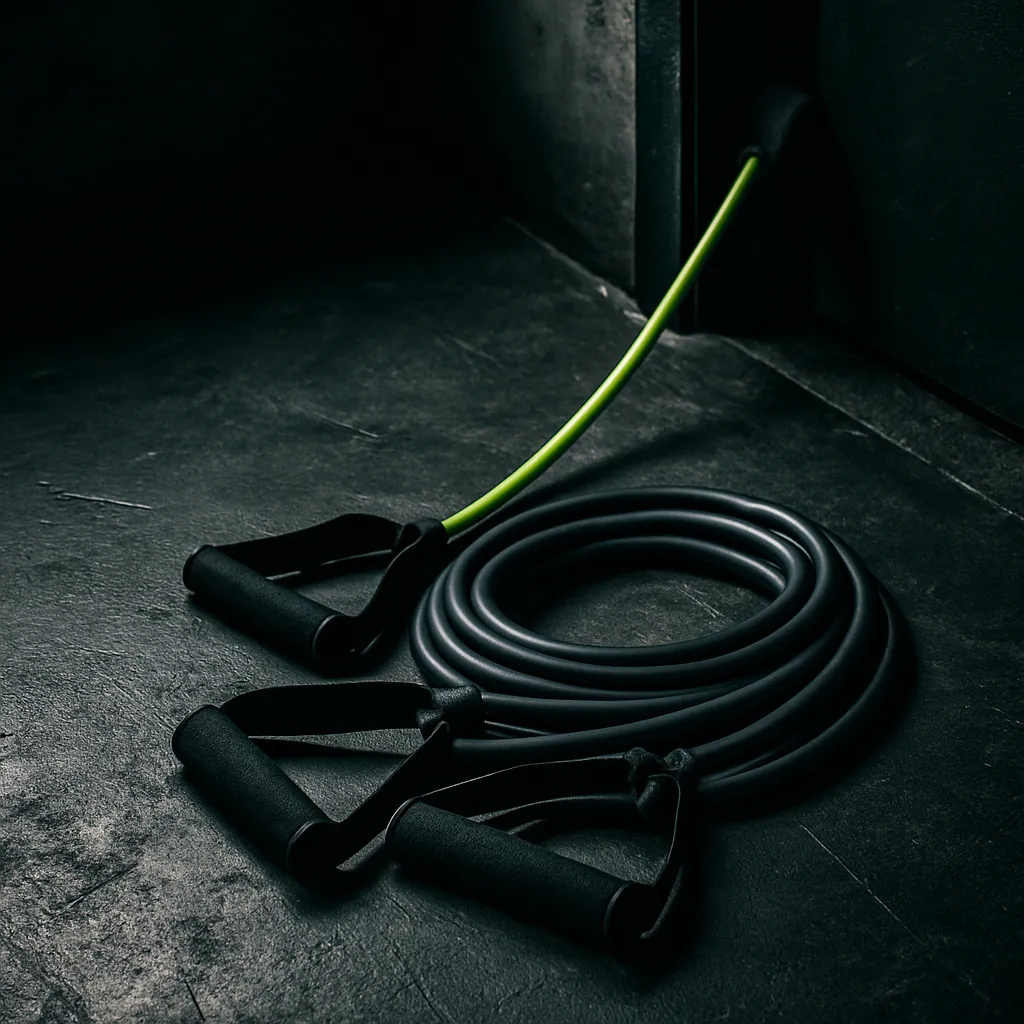
A clip-together tube set is the most practical 'pull' tool for a portable home gym. Bodylastics chains five bands (3–190 lb stacked) onto handles, ankle straps and a door anchor. Peer-reviewed reviews find elastic training builds strength comparably to free weights, with the trade-off of a load that rises through the range of motion.
Rate this pick
Our own community ratings — from confirmed Amazonia readers, never Amazon. Yours helps the next person decide, and steers what we feature next.
What does the research say about the Bodylastics Basic Series Stackable Resistance Bands Set?
Every claim below is tied to a source you can open, quoted verbatim — how we research picks.
-
“Elastic resistance training is able to promote similar strength gains to conventional resistance training, in different population profiles and using diverse protocols.”
Elastic resistance training produces strength gains similar to conventional / free-weight training.
SAGE Open Medicine (Lopes et al., systematic review & meta-analysis) · 2019 ↗ -
“ERT is a viable mode of resistance training to employ in strengthening and rehabilitation programs due to its low cost, versatility, and applicability to all populations.”
Elastic resistance is a legitimate, viable stimulus for building strength.
Sports (MDPI), systematic review of elastic resistance training · 2022 ↗ -
“the more the band is stretched, the greater the resistance to further elongation”
Honest limit: band load is not constant; it increases as the band stretches, making heavy fixed-load work harder to dial in.
Journal of Physical Therapy Science · 2016 ↗
Educational summary of the research — not medical or veterinary advice. Evidence strength varies and individual results differ; talk to a qualified professional before changing your (or your pet's) health routine.
How does the Bodylastics Basic Series Stackable Resistance Bands Set compare?
| Resistance bands | Free weights | Cable machine | |
|---|---|---|---|
| Portability | Packs in a bag | Heavy and fixed | Stationary, large |
| Resistance curve | Variable; rises through ROM | Constant via gravity | Constant, smooth |
| Max practical load | ~190 lb stacked ceiling | Effectively unlimited | Stack-limited but high |
| Joint friendliness | Low impact, light at start | Higher peak joint stress | Smooth, controlled |
| Cost | Low (one set) | Moderate-high per increment | High |
Buy it if
- Travelers and small-apartment lifters who need a full pull station in a bag
- People with cranky joints who want load that's light at the bottom of a rep
- Beginners and rehab-minded users wanting scalable, low-cost progression
- Anyone supplementing weights with mobility and accessory pull work
Skip it if
- Advanced lifters chasing heavy, constant barbell-style loads above ~190 lb
- Those who want a precise, fixed load every rep regardless of position
- Anyone with a latex allergy or a heavy-deadlift-only focus
Is the Bodylastics Basic Series Stackable Resistance Bands Set worth it?
For the 'pull' slot in a portable home gym, this is an easy recommendation: five clip-stackable tubes, real safety reinforcement, and the full handle/anchor/ankle kit at a fraction of a weight stack. The science backs bands as a genuine strength tool — as long as you accept a load that climbs through the range of motion and tops out around 190 lb.
Check price on Amazon Live price & reviews on AmazonQuestions, answered
- Can resistance bands actually build strength like weights?
- Yes. A 2019 systematic review and meta-analysis found elastic training produces strength gains comparable to conventional resistance, with no statistical superiority for either method in upper- or lower-limb strength. Source SAGE Open Medicine meta-analysis ↗
- Is the 190 lb rating real?
- It's the maximum combined tension when all five bands are stacked and stretched near full range. Because band tension rises the more you stretch, the effective load varies through the rep rather than staying flat like a dumbbell. Source Band tension behavior (JPTS) ↗
- Are bands easier on the joints?
- They tend to be, since resistance is lightest at the start of the movement where joints are most vulnerable and builds as you reach stronger positions. That ascending curve is also why very heavy, constant-load lifts remain easier with free weights. Source Elastic training review (MDPI) ↗
- Resistance bands vs free weights for a home gym?
- A systematic review found elastic training produces strength gains comparable to free weights, with no superiority for either. The trade-offs: bands pack into a bag and stay light at the start of a rep (joint-friendly), but the load rises through the range and tops out around 190 lb, while free weights give a constant, effectively unlimited load. Pick bands for portability and joints, weights for heavy constant loading. Source SAGE Open Medicine meta-analysis ↗
- Are resistance bands strong enough to keep progressing?
- Up to a point. They're a viable strength stimulus for all populations and stack to about 190 lb, but because tension rises the more the band is stretched, the load isn't constant and tops out lower than free weights. Advanced lifters chasing heavy, constant loads above ~190 lb will eventually outgrow them. Source Elastic training review (MDPI) ↗Band tension behavior (JPTS) ↗