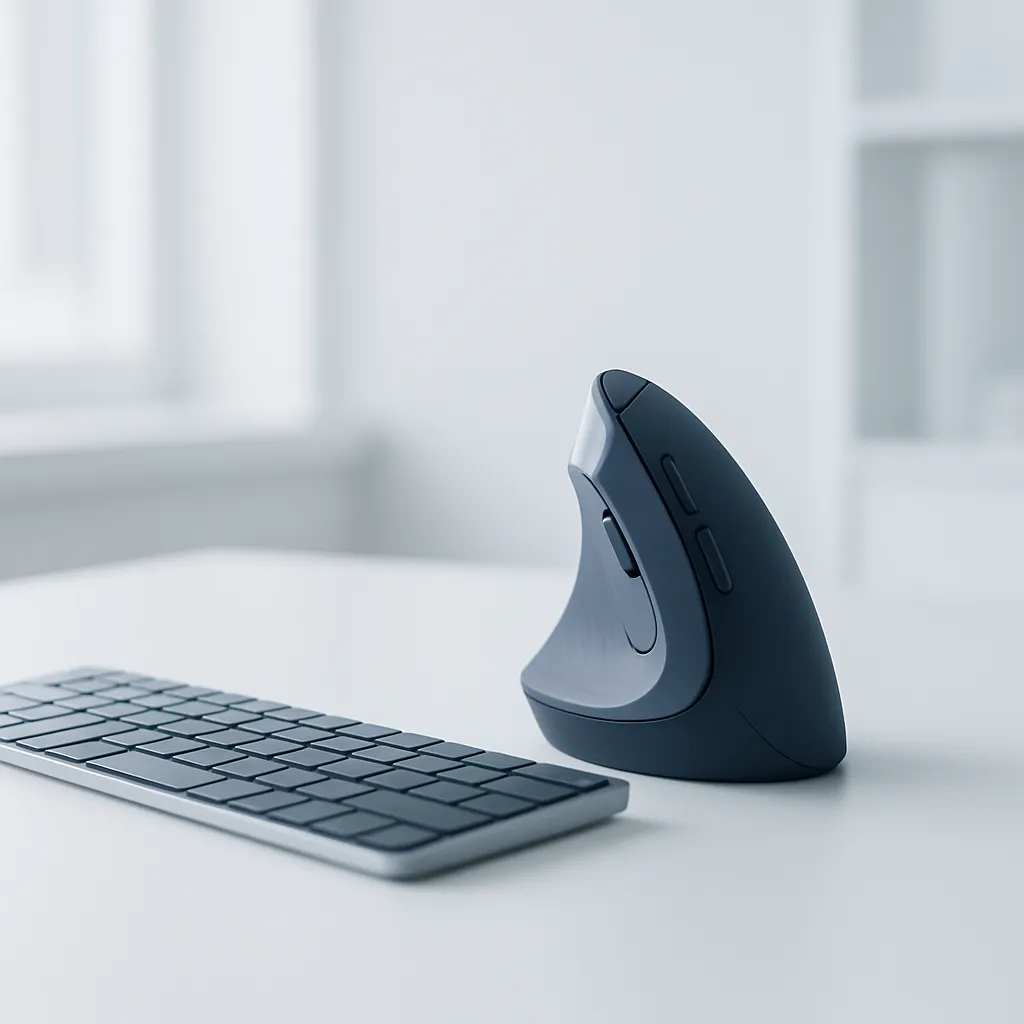
Logitech MX Vertical Ergonomic Wireless Mouse
The Logitech MX Vertical is a right-handed vertical mouse with a 57° handshake angle that holds the forearm near-neutral, reducing pronation and wrist-extensor strain versus a standard flat mouse. It uses a 4000-DPI sensor and connects via Bluetooth, Logi Bolt receiver, or USB-C, with up to four months per charge.
Rate this pick
Our own community ratings — from confirmed Amazonia readers, never Amazon. Yours helps the next person decide, and steers what we feature next.
What does the research say about the Logitech MX Vertical Ergonomic Wireless Mouse?
Every claim below is tied to a source you can open, quoted verbatim — how we research picks.
-
“The use of a vertical mouse (90°) leads the forearm to assume neutral posture (0° pronation).”
A vertical mouse moves the forearm toward a neutral, un-pronated posture.
A Design Contribution to Ergonomic PC Mice Development (PMC) · 2022 ↗ -
“there were significant differences between the VM and the SM, respectively, on motion (28° vs. 42° pronation, p = 0.001; 5° ulnar vs. 7° radial deviation, p = 0.016) and muscle activity (13% vs. 16% of extensor carpi activity, p = 0.006; 10% vs. 13% extensor digitorum activity, p = 0.001).”
Vertical mice reduce forearm pronation and wrist-extensor muscle activity versus a standard mouse.
Biomechanics & performance: standard vs vertical mouse (PubMed) · 2013 ↗ -
“Although the vertical mouse significantly reduced ulnar deviation and the gel mouse pad and gliding palm support decreased wrist extension, none of the ergonomic devices reduced carpal tunnel pressure.”
Honest caveat: a vertical mouse changes wrist position but does not lower carpal-tunnel pressure — posture help, not a cure.
Schmid et al., Applied Ergonomics (PubMed) · 2015 ↗
Educational summary of the research — not medical or veterinary advice. Evidence strength varies and individual results differ; talk to a qualified professional before changing your (or your pet's) health routine.
How does the Logitech MX Vertical Ergonomic Wireless Mouse compare?
| MX Vertical | Logitech Lift | Standard flat mouse | |
|---|---|---|---|
| Vertical angle | 57° | 57° | 0° (flat) |
| Hand size | Medium-large | Small-medium | Any |
| Connectivity | BT + Bolt + USB-C | BT + Bolt | Varies |
| Battery | Rechargeable, ~4 mo | 1× AA, ~24 mo | Varies |
| Sensor | 4000 DPI | 4000 DPI | Varies |
Buy it if
- Right-handed desk workers with medium-to-large hands
- People with wrist/forearm fatigue from a standard flat mouse
- Users wanting a more neutral, un-pronated forearm posture
- Existing Logitech MX/Bolt ecosystem owners
Skip it if
- Anyone with small hands or who needs a left-handed mouse
- Gamers needing ultra-low-latency, fast flick aiming
- People expecting it to cure an existing RSI/carpal tunnel diagnosis
Is the Logitech MX Vertical Ergonomic Wireless Mouse worth it?
A well-engineered posture upgrade: the 57° angle measurably reduces pronation and wrist-extensor load, making it a smart preventive buy for right-handed users with larger hands. Go in honest about it — it improves ergonomics, it does not cure injuries, and you will trade a bit of pointing speed during the adjustment.
Check price on Amazon Live price & reviews on AmazonQuestions, answered
- Will a vertical mouse cure my RSI or carpal tunnel?
- No. Studies show vertical mice improve forearm and wrist posture and lower muscle load, but they alter wrist position without reliably reducing carpal-tunnel pressure or curing existing injury. Treat it as prevention and comfort, and see a clinician for established pain. Source Carpal-tunnel pressure study (Schmid et al., PubMed) ↗
- Does it fit small hands or left-handers?
- It's right-handed only and shaped for medium-to-large hands. Smaller hands or anyone wanting a smaller option should look at the Logitech Lift, which shares the 57° angle. Source Logitech ↗
- How does it connect and charge?
- Three ways: Bluetooth, the Logi Bolt USB receiver, or wired over USB-C. It is rechargeable with up to four months per charge and supports quick-charge top-ups. Source Logitech ↗
- Logitech MX Vertical vs Logitech Lift vs a standard flat mouse: which?
- Both Logitech verticals use the same 57° handshake angle that a flat mouse lacks (0°). The MX Vertical suits medium-to-large hands, adds a wired USB-C option alongside Bluetooth and Bolt, and recharges (~4 months per charge); the Lift is shaped for small-to-medium hands and runs ~24 months on a single AA. Pick the MX Vertical for bigger hands and USB-C, the Lift for smaller hands and long battery life.
- Is there real evidence the 57° angle reduces wrist strain?
- Yes, and it is measured. A biomechanics study found a vertical mouse cut forearm pronation to 28° versus 42° for a standard mouse and lowered wrist-extensor muscle activity. The honest limit: it improves wrist posture but does not reduce carpal-tunnel pressure, so treat it as prevention, not a cure. Source Biomechanics study (PubMed) ↗Carpal-tunnel pressure study (Schmid et al., PubMed) ↗