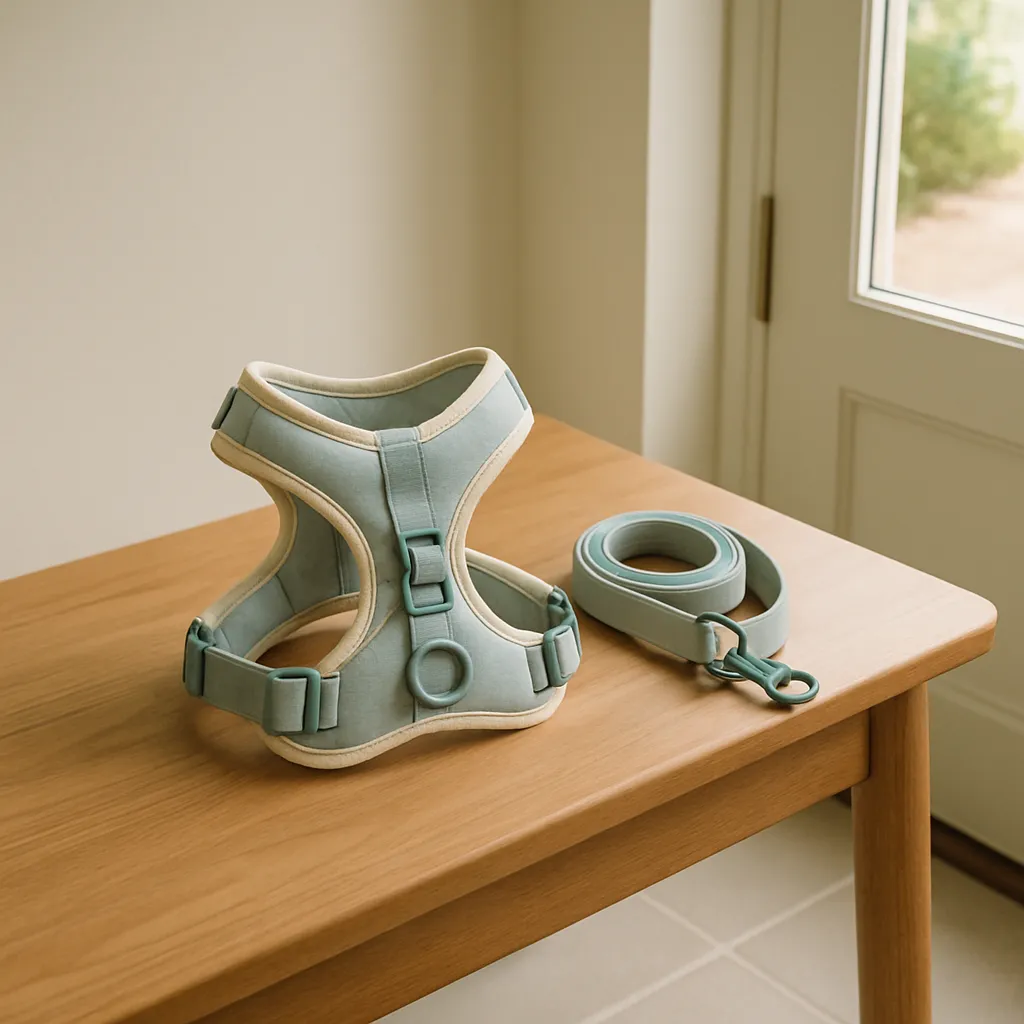
Ruffwear Front Range No-Pull Dog Harness
A no-pull harness like the Ruffwear Front Range spreads leash force across the chest instead of the neck. Vet studies show a collar raises intraocular pressure when a dog pulls while a harness does not, and front-clip harnesses reduce pulling. It manages pulling; it does not train the dog.
Rate this pick
Our own community ratings — from confirmed Amazonia readers, never Amazon. Yours helps the next person decide, and steers what we feature next.
What does the research say about the Ruffwear Front Range No-Pull Dog Harness?
Every claim below is tied to a source you can open, quoted verbatim — how we research picks.
-
“Intraocular pressure increased significantly from baseline when pressure was applied via a collar but not via a harness.”
A collar raises intraocular pressure when a dog pulls against it; a harness does not.
Pauli et al., Journal of the American Animal Hospital Association (PubMed) · 2006 ↗ -
“Exercising in a collar increased IOP for both groups of dogs (p < 0.05), whereas exercising in a harness did not affect IOP for either group (p > 0.05).”
Exercising in a collar raises intraocular pressure, whereas exercising in a harness does not.
Bailey et al., Veterinary Medicine and Science (PubMed) · 2025 ↗ -
“For dogs that pull, non-tightening front-clip harnesses appear to offer the best balance between discomfort and reduction in pulling.”
For dogs that pull, a non-tightening front-clip harness is the best-balanced choice — but it manages pulling rather than training it away.
Review of Collars, Harnesses, and Head Collars for Walking Dogs, Animals/MDPI (PubMed) · 2025 ↗
Educational summary of the research — not medical or veterinary advice. Evidence strength varies and individual results differ; talk to a qualified professional before changing your (or your pet's) health routine.
How does the Ruffwear Front Range No-Pull Dog Harness compare?
| Ruffwear Front Range | Neck collar | PetSafe Easy Walk | |
|---|---|---|---|
| Where force lands when pulling | Across chest (Y-front) | On neck / trachea | Across chest (front strap) |
| Leash attachment points | 2 (front + back) | 1 (neck ring) | 1 (front only) |
| Raises eye pressure on pull | No | Yes | No |
| Adjustment points | 4 | 1 | 4 |
| Chest construction | Y-front, clear of shoulder | N/A | Strap across shoulders |
Buy it if
- Owners of dogs that pull who want force off the neck and throat
- Dogs with eye conditions or a collapsing-trachea risk
- People who want one harness for training (front clip) and relaxed walks (back clip)
- Daily walkers who value a padded, reflective, well-adjustable Y-front fit
Skip it if
- Owners expecting the harness alone to cure pulling without any training
- Extreme, determined pullers who may redirect better on a head halter
- Escape artists or unsupervised chewers who can wriggle or destroy a harness
Is the Ruffwear Front Range No-Pull Dog Harness worth it?
The best-evidenced default for a dog that pulls: a true Y-front that keeps load off the neck, with dual clips covering both training and casual walks. Honest caveat — it manages pulling, it doesn't train it. Pair the front clip with loose-leash practice and it earns its place.
Check price on Amazon Live price & reviews on AmazonQuestions, answered
- Does a front-clip harness stop pulling on its own?
- No. It makes pulling less rewarding by redirecting the dog sideways, which is why studies rate front-clip harnesses best for pullers — but it manages the behavior. Lasting loose-leash walking still comes from training. Source MDPI/Animals review (PubMed) ↗
- Why is a harness safer than a collar for a dog that pulls?
- Collar pressure on the neck compresses the throat and raises intraocular pressure when a dog pulls; a harness spreads that force across the chest and does not raise eye pressure. Source J Am Anim Hosp Assoc (PubMed) ↗Veterinary Medicine and Science (PubMed) ↗
- Front clip or back clip on this harness?
- Use the front chest clip for pullers and training — it turns the dog toward you. Use the rear V-ring for calm, trained dogs or activities where you want them out front. Source Ruffwear Front Range product page ↗
- Ruffwear Front Range vs PetSafe Easy Walk: which no-pull harness?
- Both keep leash force across the chest rather than the neck, neither raises eye pressure on a pull, and both have 4 adjustment points. The difference is build: the Front Range is a true Y-front that sits clear of the shoulder joint with two clips (front + back), while the Easy Walk runs a strap across the shoulders with a single front clip. Choose the Front Range for the shoulder-clear Y-front and dual attachment.
- Is a harness better for a dog with eye problems or a collapsing trachea?
- Yes. Vet studies show intraocular pressure rises significantly when a dog pulls against a collar — and even just exercising in a collar raises IOP — whereas a harness does not, and it keeps compressive force off the throat and trachea. For dogs with eye conditions or a collapsing-trachea risk, a Y-front harness that spreads load across the chest is the safer choice. Source J Am Anim Hosp Assoc (PubMed) ↗Veterinary Medicine and Science (PubMed) ↗