Barrina Grow Lights for Indoor Plants, Full Spectrum, 2ft 40W (250W Equivalent), T5 LED Strips, 4-Pack
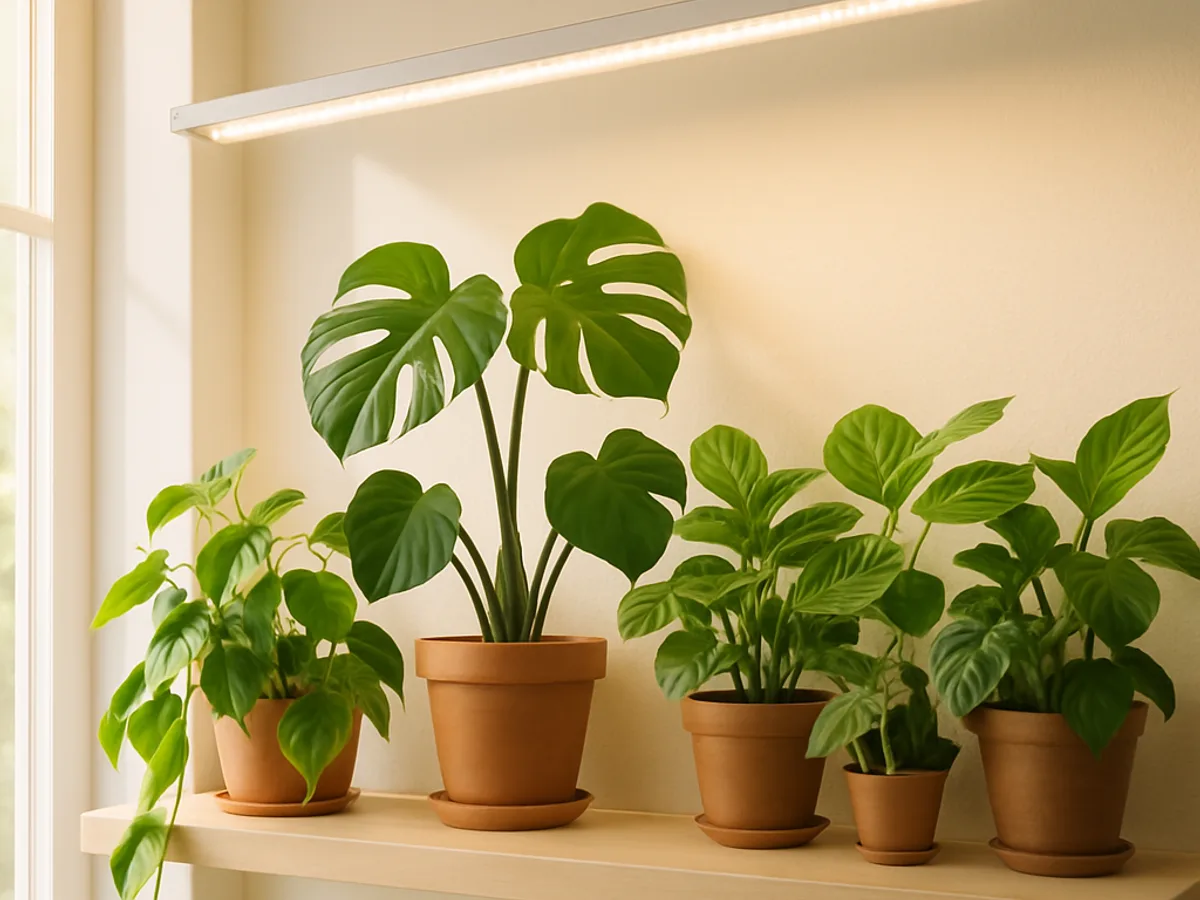
Yes — the Barrina T5 is the best-value way to fix the #1 indoor-plant problem (not enough light). It puts out full-spectrum, energy-efficient LED light in the red and blue wavelengths plants actually use for photosynthesis, runs cool, and links together so you can cover a whole shelf for the price of one designer clip lamp. It supplements or replaces a weak window; it does not make a plant that wants shade suddenly crave blazing light.
Rate this pick
Our own community ratings — from confirmed Amazonia readers, never Amazon. Yours helps the next person decide, and steers what we feature next.
What have experts found about the Barrina Grow Lights for Indoor Plants?
Every claim below is tied to a source you can open, quoted verbatim — how we research picks.
-
“All plants require light for photosynthesis, the process by which a plant uses light to convert carbon dioxide and water into carbohydrates (energy).”
Light is essential and limiting for indoor plants — without enough of it, plants decline.
University of Minnesota Extension · n.d. ↗ -
“The part of the light spectrum that plants use is called Photosynthetically Active Radiation, which is composed of primarily red and blue light.”
Plants use specific wavelengths — primarily red and blue — which is exactly what full-spectrum grow lights target.
University of Minnesota Extension · n.d. ↗ -
“Light is probably the most essential factor for healthy indoor plant growth.”
Light is the top factor for indoor plant health — but you should match the plant to your light, not just add more.
University of Maryland Extension · n.d. ↗
How does the Barrina Grow Lights for Indoor Plants compare?
| Barrina T5 full-spectrum LED | A sunny windowsill | A regular household lamp | |
|---|---|---|---|
| Light plants can photosynthesize with | Full-spectrum, red + blue tuned for plants | Full daylight spectrum — only when actually sunny | Little usable red/blue at plant distance |
| Reliability | Consistent every day, easy to put on a timer | Swings with season, weather and window direction | Not designed for plant growth at all |
| Intensity you can control | Adjust by height and daily hours | Fixed — can scorch or leave plants starved | Too weak to drive real growth |
| Running cost / heat | ~40W efficient LED, runs cool | Free but unpredictable | Inefficient, mostly wasted as heat |
Buy it if
- Plant parents with a dim apartment or north-facing windows where nothing thrives
- People growing a shelf or rack of houseplants who want to light many pots cheaply
- Seed-starters and propagation hobbyists who need consistent full-spectrum light
- Anyone who wants a low-heat, plug-and-play setup they can put on a timer
Skip it if
- Someone who only needs to boost one small pot — a single clip-on bulb is tidier
- Plant parents who already have a genuinely bright, sunny window that's working
- People wanting a decorative lamp — this is a utilitarian strip, not a design piece
Is the Barrina Grow Lights for Indoor Plants worth it?
The Barrina T5 is the value king for the Plant Parent's most important need: real, usable light. Full-spectrum, cool-running, linkable and cheap per pot. Mount it, put it on a timer, tune the height and hours to each plant, and watch the sulking stop.
Check price on Amazon Live price & reviews on AmazonQuestions, answered
- Grow light vs a bright window vs a normal lamp — which does my plant actually need?
- A bright window is great when it's genuinely bright, but light indoors drops off fast and swings with season and weather. A regular household lamp produces almost nothing plants can use for growth at pot distance. A full-spectrum grow light like the Barrina delivers the red and blue wavelengths of Photosynthetically Active Radiation consistently, every day — so it either replaces a weak window or reliably supplements a good one. Source UMN Extension — Lighting for indoor plants ↗UMD Extension — Lighting for indoor plants ↗
- Do plants really use different light than I see?
- Yes. Plants photosynthesize mostly with red and blue wavelengths — the band called Photosynthetically Active Radiation. A 'full-spectrum' grow light is built around delivering that usable light, whereas a normal bulb is optimized for how a room looks to your eyes, not for driving plant growth. Source UMN Extension — Lighting for indoor plants ↗
- Can I just leave it on 24/7? Isn't more light always better?
- No — more light isn't automatically better. Plants need a daily dark period, and extension guidance caps supplemental light at no more than 16 hours per day. Match the hours (and intensity) to the plant: shade-lovers can be stressed by too much, while high-light plants want more. Put it on a timer and tune it to the species, not to the maximum. Source UMD Extension — Lighting for indoor plants ↗
- How far above my plants should the strip sit?
- Distance sets intensity: the closer the strip, the stronger the light a plant receives. Start a few inches to a foot above the canopy and watch the plant — pale, stretched growth means it's too far or too dim, while scorched or bleached leaves mean it's too close or too intense. Adjust height per plant rather than assuming one setting fits your whole shelf. Source UMN Extension — Lighting for indoor plants ↗